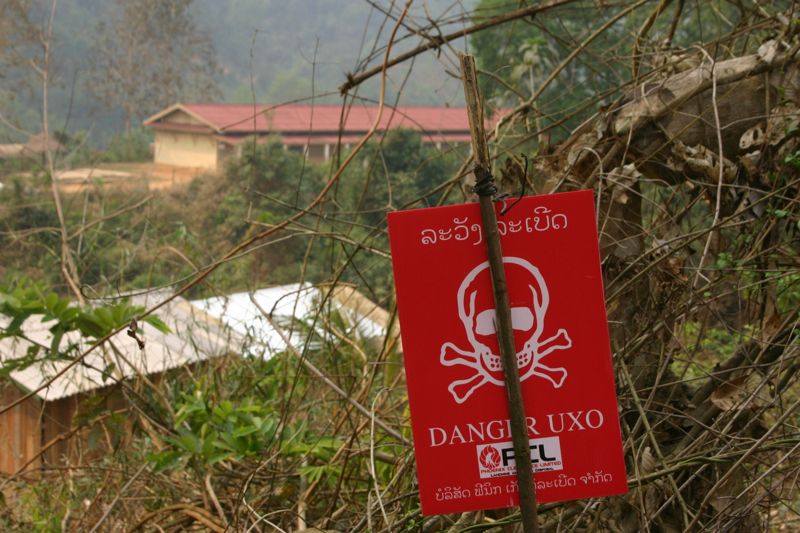
Project Phongsali: The village school is within lethal range of cluster munitions. The school was built on uncleared land!
Days 26 and 27
The local elementary school sits at the base of a steep hill that is covered with dense vegetation. You’d need an outfielder’s arm, but if you can throw a baseball from shallow center field and hit home plate, then you’ve got the strength to could throw a rock from the top of that hill and hit the schoolhouse door. Here’s why that’s significant.
At the moment, villagers are cutting the brush on the hillside with the intent of burning the cut vegetation as soon as it’s dry enough to light. (In Laos there are two seasons, the dry season and the rainy season; some people call the last few weeks of the dry season the “burning season” because that is the time in which slash-and-burn farmers set their fields aflame.)
The problem we discovered yesterday is that the field above the school, the field that’s soon to be burnt, has ordnance sprinkled about. Mostly, the items are sub-munitions known as M-83’s. They’re an American made, American delivered bomblet that’s styled after the “butterfly bomb” that Germany dropped on England during World War II. (We’re finding them here in greater numbers than I’ve seen before. The butterfly-like “wings” are a fluttering device built into the bomb to arm it before it hits the ground).
The M-83 is more powerful than most of the other cluster munitions that we see. (It was as much an “anti-vehicle” weapon as “anti-personnel”). If an M-83 explodes on the hill above the school, the children on the playground below will be well within lethal range of its shrapnel.
Obviously, something has to be done. Soon, before someone lights that field.
Day 27
When we visit schools we take along our photographs of UXO and our posters that visually convey safety messages. Written messages on posters are not particularly useful here, with either adults or children, given the low level of literacy. School children here have irregular attendance and are slow to learn to read with fluency due to a shortage of reading material. And, there is the ongoing problem of teacher absenteeism. It all adds up to low time on task and poor reading achievement.
What we don’t take with us are actually examples of disarmed UXO. It’s tempting to put the real-life item in front of the kids so they can visualize what devices actually look like but that would violate a cardinal rule of risk education: Never let villagers see a clearance worker handle ordnance. If they did, they might copy the behavior with the wrong ordnance and get hurt.
What we do take to the schools are soil-filled boxes decorated with plastic plants to realistically represent several environments: a walking path, garden patch, or rice field. In the boxes, among the plants, we have parts of UXO that give the viewer a good idea of what they would see if they encountered ordnance around their village.
Unfortunately, the boxes we’ve used for the past four years were too bulky to transport here, so we’ve got to rebuild them from scratch. I brought plastic plants from home and Yai’s job today will be to add soil, rock, leaves, and twigs to the boxes to make them as realistic as possible. Next week we start school visits here and in the neighboring town of Muang May.
Every day we add more ordnance to our work list. We have looked at a few places where villagers say they buried ordnance under a few inches of dirt. (Under a tree, beside a rock, in a crater) but we can’t take a shovel to any of those items yet, since we don’t have a medic with us now. The medic will come up with the rest of the team in a few days. For the moment all we can do is mark the site and promise to inspect again next week.