A book of his adventures
Jim's Story
A Wisconsin elementary school principal who spent the second half of his working life clearing unexploded bombs from Lao villages. Twenty-two years of field journals, told here mostly in his own words.
Jim Harris has lived two lives. In the first, he taught kindergarten in Wisconsin, wrote social studies textbooks used in classrooms across America, and spent twenty years as a school principal good enough to be named the state's Elementary Principal of the Year. In the second, beginning in 2006 when he was already past most people's idea of retirement age, he picked up a metal detector in the highlands of Laos and began clearing the ordnance that had been killing Lao villagers — children, mostly — for forty years.
Both lives were lived with the same instincts: pay attention to specific people, take their lives seriously, write everything down. What follows is a path through the second life as he recorded it on this site between 2004 and 2021 — a kind of book of his adventures, assembled from the field journals he posted as he went.
I. The Wisconsin Years
Jim began his career as a teacher in the Wisconsin Indian Teacher Corps, working with children of the Ho Chunk Tribe near Black River Falls. While teaching he produced "Winnebago Voices," the first radio program in Wisconsin to discuss news and culture in a Native language. He spent ten years in the classroom, became one of the first male kindergarten teachers in the state, and somewhere along the way wrote primary-grade social studies and science textbooks — Holt Social Studies, Science Horizons — that ended up in classrooms nationwide.
Twenty years as a school administrator followed. The local paper mill, after public advocacy from Jim about the health of his students, installed several million dollars in new pollution controls; the Washington Post took notice. The Wisconsin Department of Public Instruction named him the state's Elementary Principal of the Year. He and his wife Marty — also a career teacher, in English and art at Wausau — were honored by the Wisconsin United Coalition of Mutual Assistance Associations for their work with Hmong refugee families resettled in central Wisconsin.
That last detail is the seed. Through three decades of teaching, the Harrises came to know Hmong and Lao parents and grandparents who had been displaced by the Indochina War. They learned the histories. Then, beginning in 2000, they started traveling to Asia to visit the relatives those families had left behind.
II. How Laos Began
The trips multiplied. By the time he was filing field journals on this website, Jim had been to Laos a dozen times. The first trips were about reconnection — finding the cousin, the grandmother, the village a Wisconsin family had escaped from in the 1970s. But Laos was full of evidence of a war the United States had largely chosen to forget: bomblets in gardens, rockets in tree stumps, the Plain of Jars rendered into a museum of ordnance.
In 2006, Jim began working with Phoenix Clearance Ltd., a New Zealand company doing humanitarian demining. He joined a rapid-response team in Nakai District, Khammuan Province — the team called when villagers discovered something dangerous. He was sixty-something. He kept going back.
III. Field Notes from a Newcomer
The earliest posts on the site read like field journals from a curious teacher who happens to find himself in a tent in the highlands. The observations are patient. The questions are open. He invites his students back home into his thinking.
From "Attack of the Ants", April 2006:
An electrical wire runs head-high through my tent. That's "head-high" when measured against the Lao guy who strung the wire. I catch it under my chin several times a day. Each time I clothesline myself, the wire twangs like a guitar string and pitches the ants that are walking on the wire off into the wild blue yonder.
Don't feel sorry for the ants. Every ant that I've tracked has hit the ground running. Not having much to do in camp after the sun goes down, I've found time to ponder the size of the ant in comparison to the height of the wire. Those falling ants experience a drop that would be equal to a dive from a height of 720 feet for me! Obviously, I would not hit the ground running.
Two paragraphs in and he's measuring an ant in proportion to a man — the first instinct of a kindergarten teacher who has spent thirty years explaining the world to small humans. A few paragraphs later, in the same post, the educator turns toward home:
If I had an encyclopedia here, I could do some research and learn more about insect communication. If any Wausau, Everest, or Stevens Point students have the resources to research ant behavior, I'd appreciate hearing from them.
The same year he was bitten by a scorpion that had crawled into his sock. The wedding ring he hadn't taken off in thirty-six years was still on the finger. From "I get bit by a scorpion and need help fast":
On my own personal pain scale I'd rate it on par with the day I learned that it is not a good idea to fish bread out of the toaster with a metal knife.
The drive to the nearest village to find a Vietnamese jeweler willing to cut a ring off a swelling finger is a small adventure with stakes. The telling makes it funny. The voice — self-aware, dry, attentive to the absurdity of the situation he's gotten himself into — runs through every one of the 325 essays on this site.
IV. A Day in Phongsali
By 2010, Jim was running multi-week operations of his own. Project Phongsali was a clearance campaign in one of the country's most underserved northern provinces, and he wrote daily diaries from camp.
From Diary, Week One:
I arrive in Vientiane at midday on a flight from Taipei via Bangkok. My assistant and interpreter, Bounnphasit Xayavong, "Yai" to his friends, picks me up at the airport.
It's the peak of the tourist season and I have no hotel reservation but I am confident that there will be room for me at my Lao "home from home," the Soukxana Guest House. (The Soukxana, at 13 bucks a night, occupies a sweet spot: too expensive for backpackers and too seedy to appeal to better-heeled tourists.)
The diary entries that follow are operational and patient: which forms have to be filed at which provincial office, what to pack into the truck for a three-week stay (TNT, drinking water, spare batteries, six new Book Box libraries for rural elementary schools), which villages have requested help, how the team will set camp.
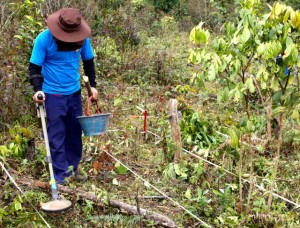
The work itself is slow. A clearance team walks land in narrow lanes with metal detectors. The "scrub cutters" go ahead of the deminers — one of the oldest titles in the work, and one Jim respects in the writing: every person on the team has a craft. Each square meter is checked. When a detector pings, the operator stops, marks the spot, and waits. Sometimes it's an old shovel head. Sometimes a 750-pound bomb.
He wrote about the economics of the work, too — about the men and women he worked beside. From "Aspirations," 2010:
Eighty-five per cent of the people in Laos practice subsistence agriculture in which they consume almost everything they produce and have little surplus to sell for cash. Those Lao who work for wages accept pay that most Americans would consider extraordinarily low.
All of which is to say that clearance work, while dangerous, is well paid relative to Lao standards. […] Over the past four years I've watched hundreds of clearance workers collect their wages and spend their money. Some have little to show for their years of dangerous work. But most…by far the most… have steadily improved their family's quality of life.
The teacher's eye again: paying attention to outcomes, watching what happens to people over years, refusing to flatten them into "the locals."
V. People With Names
One of the most distinctive things about Jim's writing is that he names people. Most accounts of nonprofit work in faraway places dissolve into abstraction — "the villagers," "local staff," "beneficiaries." Jim names everyone. Yai, the interpreter who worked with him for seven years. Kham, who runs the truck. Om, who knows where the bridges are out. Buntavee, who drove him to the Vietnamese jeweler the day of the scorpion.
And then there are the people he meets only briefly — the village experts, the children, the parents — whom he names anyway because not to do so would feel like a small theft.
From "Mr. Magnet was a rarity," March 2016:
Most provinces in Laos are underserved by humanitarian clearance organizations. Given the rate at which unexploded ordnance is being rendered safe, the bombs, rockets, mortars, bullets and shells that blight 2,500 villages here will outlive every human now living on our planet.
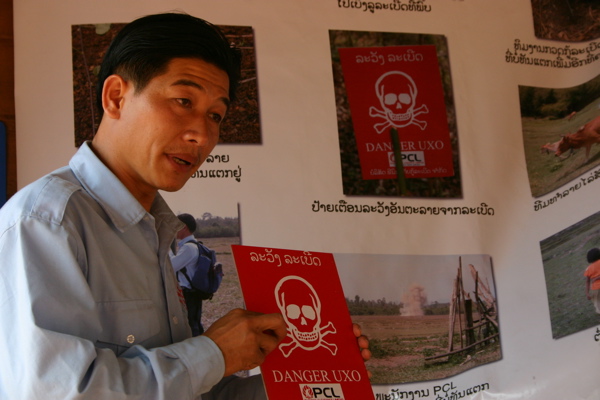
In underserved locations self-trained, self-proclaimed, amateur, bomb experts step up and offer their services — albeit, at a price. Need a bomblet removed from the family garden? Police won't help; find the village expert. Children walking to school are stepping over a bomblet exposed by recent rains. Military won't help; find the village expert.
The piece is a portrait of a man — Mr. Magnet — who taught himself to remove ordnance because no one else was going to come, and who managed to do it for years without dying. Jim's verdict: he gave his trade a good name. The respect is real, even though Mr. Magnet does the work outside every standard of professional safety. The teacher honors the apprentice's knowledge.
VI. The Schoolgirl in the Garden
The most affecting piece on the website was filed in February 2015. It is the story of Sunsamay, a twelve-year-old girl from Dak Cheung District who died on the edge of her family's coffee garden after her hoe brushed a twenty-millimeter shell that had been waiting in the soil since before her parents were born.

Jim writes the moment carefully. He had been weeding around tender coffee seedlings beside her mother. At dusk she walked back to the motorbike with her long-handled hoe, using it as a walking stick, swinging the head down ahead of her each step.
Step…step…step…swing…thump.
Step…step…step…swing…thump.
And then…
Step…step…step…swing…CLINK.
From the post:
It was her family's misfortune that they didn't make the cut last year; forty-six other families did. It was Sunsamay's personal misfortune that she happened upon a piece of ordnance that had waited forty years to perform its deadly function; there are few killers more patient than unexploded ordnance. It's my burden that, while my staying power depends on the conviction that we save lives, I must now live with the reality that we can never, ever, do enough.
Five months later he visited Sunsamay's parents. They walked the garden with him for the first time since her death. They reconstructed the moment and shared every detail they could remember. Jim records what they did, and why:
With grace, they did this for me because I told them I wanted to share their daughter's story with the world. I can only hope they are correct in believing that the world will care.
That sentence is the moral center of the website. The whole project — the UXO clearance, the medical care, the libraries, the coffee — runs back to a question of whether the world will care, and to a stubborn decision to make it care, one named child at a time.
VII. A Library, A Bridge, A Coffee Garden
The work that wraps around UXO clearance is hard to summarize because it accumulated in pieces, year by year, as Jim noticed needs and tried to meet them.
Forty-plus rural Lao schools received their first libraries because Jim had the Lao National Library construct Book Boxes — heavy wooden chests packed with two hundred Lao-language children's books each — and he carried them in trucks to villages that had been begging for reading materials for years.
When his teams found victims of birth defects, untreated injuries, or long-deferred surgical needs, he raised funds for surgery and prosthetics. When the cluster bombs in the soil prevented a family from planting a cash crop, his team cleared the land. When the family's land was too far from a clinic, the family came along to the clinic.
And when the families whose land had been cleared began to plant coffee in the safe earth, Jim started buying their harvests and selling the roast back home. From the most recent post on the site, October 2021:
As our supporters savor a steaming cup of coffee they can take both pride and comfort from the knowledge that their purchase of Lao Mountain Coffee pays the wages of the brave Lao men and women who locate and destroy explosive remnants of war.
A circle, eventually. Cleared land becomes a coffee garden becomes the income that funds next year's clearance. Half the annual budget, by the time he wrote that post.
VIII. The Long Memory
Alongside the demining and the libraries and the surgery, Jim and Marty spent a quarter-century assembling a museum-quality collection of Lao, Hmong, Khamu, and Akha artifacts: crossbows, spirit knives, whiskey stills, fishing traps, fortune cards, water vessels, a wooden leg. They did this because the cultures the war had displaced were also being lost — slowly, not by ordnance but by erosion — and because Jim was, fundamentally, a teacher who understood the value of objects in a classroom.
The artifact collection is one of the unusual things about this nonprofit. The same hands that pulled bombs from coffee gardens also catalogued a weaving device, an oil lamp, a pair of funeral shoes. Both gestures presume the same thing: that these lives are worth preserving in their specifics. All 278 photographs are here.
IX. After Twenty-Two Years
The most recent post on the website was filed in October 2021. There has not been another since. Jim is older now, the trips are harder, the contractor is no longer in country, and the work continues — the way work like this continues, in pieces, with the help of the people who have stayed close.
What persists is the writing. Three hundred and twenty-five field journals spanning seventeen years of regular posting. Field reporting from a small province most Americans cannot find on a map. A small museum's worth of photographs. A coffee operation that, on its quietest day, still funds a deminer's wage.
And a single sentence, written in 2015, that earns its place at the head of everything: I can only hope they are correct in believing that the world will care.
Read more
The seven posts excerpted above are a thin slice of what's on this site. If you want to keep reading, these are the pieces to start with:
- "Twelve-year-old dies in the family garden" — Sunsamay's story (February 2015).
- "Diary, Week One" — the beginning of the forty-post Project Phongsali series (February 2010).
- "Attack of the Ants" — the curious-newcomer voice in its first form (April 2006).
- "Mr. Magnet was a rarity" — a portrait of a self-trained village bomb expert (March 2016).
- "I get bit by a scorpion and need help fast" — early Jim, with a wedding ring problem (August 2007).
- "Half of our annual budget" — the coffee model in his own words (October 2021).
- The full archive — all 325 essays, browsable by year.
If this work matters to you, the most direct way to support it is to give or to buy a bag of coffee. Every dollar funds direct work in Lao villages.