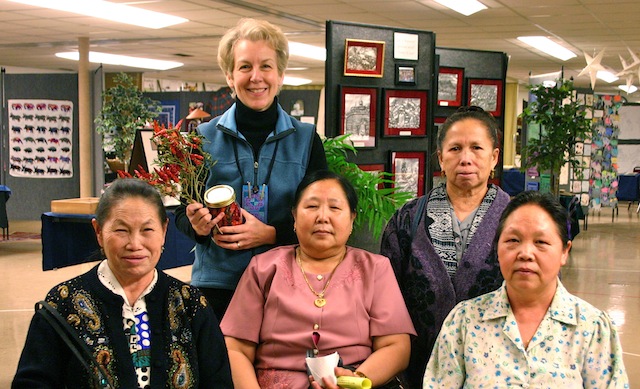
A partner in the work
Marty's Story
Teacher, art educator, Hmong cultural advocate, and the partner without whom the long arc of this nonprofit doesn't run.
Marty Harris is half of why this organization exists. She rarely turns up on the byline, but she is in nearly every story Jim tells — sometimes by name, often by the long shadow she casts as the half of the partnership who keeps things running, raises the money, runs the artifact collection, and answers the phone in Wisconsin when Jim is in a tent in Laos.
I. The Educator
Marty graduated from Miami University in Oxford, Ohio with a teaching certification and a bachelor's degree in English, then completed an art major through the University of Wisconsin system, then earned a master's in Curriculum and Instruction from Aurora University.
She began her teaching career with junior-high students in inner-city Columbus, Ohio. Early in her career — and importantly for what came later — she taught composition and writing to students of the Ho Chunk Tribe near Black River Falls, Wisconsin, the same community where Jim was working in the Indian Teacher Corps. For twenty years she taught English and art in the Wausau School District, a small city in central Wisconsin that, between the 1970s and 1990s, became one of the most significant Hmong refugee resettlement communities in the United States.
She worked with Very Special Arts–Wisconsin to develop a curriculum that allowed students with exceptional educational needs to participate fully in the visual arts, and served on the state organization's board. The Marathon County Department of Special Education named her "Support Teacher of the Year" for that work.
II. The Long Apprenticeship in Hmong Culture
The arc of Marty's later work begins in her Wausau classroom. As Hmong enrollment in the district grew, she committed herself to learning more about Lao and Hmong cultures — not as background research but as a craft she wanted to teach competently.
That commitment took her to Southeast Asia, again and again, to meet the extended families of her Hmong-American students and to begin collecting artwork and everyday artifacts that captured living culture. The Wausau honorific — the Wisconsin United Coalition of Mutual Assistance Associations naming her and Jim for their work on behalf of Hmong families, and the Wisconsin Department of Public Instruction naming them "Outstanding Global Educators" — followed.
The artifact collection on this site, with its 278 photographs of crossbows, spirit knives, fishing traps, fortune cards, and water vessels, is largely her work as much as Jim's. She has been the curator. She has done the patient work of documenting where each object came from and who used it. It's all here.
III. In Jim's Field Journals
Jim writes about Marty often, usually in passing — the way someone writes about the person they've been married to for half a century. Two glimpses will do.
From "Pi Mai: Buddhist New Year," April 2006, on a Lao street during the holiday's three-day water-soaking celebration:
One afternoon Marty and I gave as good as we got. We attached ourselves to a group on the street that was armed with squirt guns, hoses, buckets and pails. We cheerfully washed away bad luck from every soul that passed our way. If we neglected to bless some old ladies and small children it was only because, walking slowly, they offered so little challenge. Marty and I congratulated ourselves for bringing an element of our Judeo-Christian traditions to the holiday: "It's better to give than to receive."
From a 2012 Sekong dispatch, on the morning he discovered marauding pigs had eaten his camp's sugar stores:
After being out of phone range for several days, my morning high was hearing Marty answer her cell phone in Wisconsin.
Two sentences, in passing. The whole shape of a long marriage with a Lao dirt road running through it.
IV. The Officer of the Corporation
Inside the formal structure of the nonprofit, Marty is Secretary and Treasurer of the board. That's the line on the IRS Form 990-N. The more accurate line is that she is the half of the operation that does the things one does not write field journals about: the bank accounts, the mailings, the donor receipts, the artifact intake, the question of whether there is enough money for next year's coffee shipment.
Without that work, the whole project that Jim's field journals describe would not have held together for twenty-two years.
The most direct way to support both halves of the partnership is to donate or order Lao Mountain Coffee — every dollar funds the fieldwork in Laos and the cultural work in Wisconsin alike.