Project Phongsali 2011: The more we look, the more we find.
Week Three
Day Eighteen:
A couple of days ago an American couple living in Muang May invited me for a breakfast of coffee, fruit, bacon and eggs, an enjoyable change of pace after weeks of standard Lao breakfast fare: noodle soup, steamed greens and sticky rice. But, what I enjoyed most and devoured with gluttonous abandon were warm biscuits slathered with butter and smeared with a shameless quantity of homemade “goat-nipple-fruit” preserves. (Take note Smucker’s: with a name like “goat-nipple jam”… it’s really got to be good!)
My new friends are Alan and Janet Bemo, volunteers with the Christian Reformed World Relief Committee (CRWRC), a non-government organization approved by the Lao government to do community development in the southern districts of Phongsali province.
The Bemo’s and I discussed the UXO that I have documented throughout the May and Khoua districts and, together, we poured over my maps to see if their current work takes them into contaminated areas. Like most aide workers who come to Phongsali, Alan and Janet had never seen the detailed bomb data maps that clearance companies use to gauge the likelihood of contamination. (Sadly, that lack of orientation will probably result, some day, in a volunteer falling victim to an accident).
Today, Alan joined me on a five-minute walk from the main market to a hillside garden where our team was preparing to destroy a cluster bomblet. In spite of our previous conversations about the likely existence of UXO within the village, Alan expressed surprised when he saw how close today’s demolition was to shops and homes.
As we were returning to the town center after completing the demolition a lady stopped us to say that, had she known our team was coming to remove ordnance, she would not have recently carried five bomblets from her garden to the river.
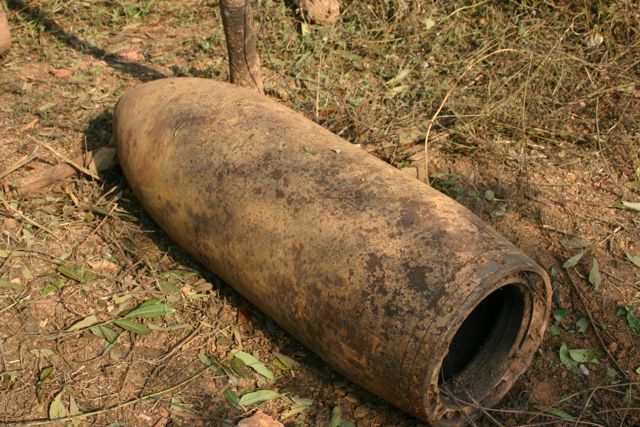
The capper for the morning was when Alan mentioned a landmark in the center of the village that he passes by every day— the casing of a 750-pound bomb standing upright, like a miniature Washington’s monument, in front of the naiban’s house. Hoping to get a rise out of Alan I said, “Don’t be surprised if it turns out to be a live bomb!”
To check that possibility Alan and I went directly to the casing. We discovered that the bomb’s front fuse and booster were still intact, and that the casing had an unhealthy remnant of explosive in its nose. Before doing anything else, the deminers loaded the casing in our truck, hauled it safely out of town, and destroyed the fuse, booster and residual explosive.
It’s now back in its place of prominence, but no longer capable of spewing deadly flame and shrapnel on bystanders.