Project Sekong 2012: We deliver surplus medical supplies to hospitals and clinics.
Report 36
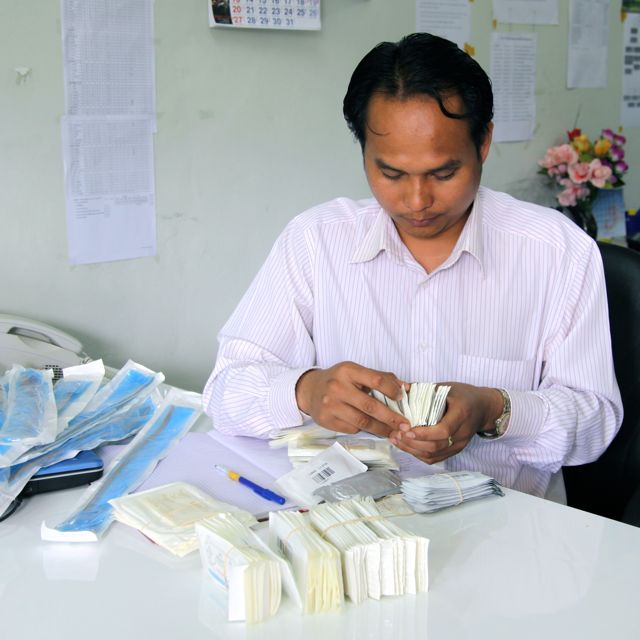
I usually arrive in Laos carrying medical supplies that donors collect for me throughout the year, items that American clinics discard when they update their inventory of supplies. Often, the items are in excellent condition but are approaching an expiration date.
I won’t deliver prescription or over the counter drugs even though they’re badly needed here. I don’t want to chance having drugs misused, or of having patients treated with drugs that have outlived their effectiveness.
If you aspire to be a pharmacist here, about all you need to do is purchase a white coat and set up shop. And, patients here don’t need a physician’s prescription in order to purchase drugs. The wives of a couple of our deminers moved up from selling dry goods in a street-side stall to selling pharmaceuticals, without obtaining any pharmacy education.
The casual approach to dispensing medicines leads to interesting behaviors. Often, the guys on our team will compare the medicines they’ve received from different pharmacies and then swap pills so each has a combination of shapes and colors, assuring the desired “shotgun” approach to treatment.
Most items that I donate are common in America but rare or expensive here. In even the best hospitals, in the largest Lao cities, disposable gloves are a luxury item. Staff in hospitals here wash what are intended to be disposable gloves again and again. One Lao nurse told me that her standard procedure is to wash gloves twenty times before discarding. (But, she admits that she often loses count and simply uses gloves until they wear through.)
Sutures are often in short supply, and I’ve had doctors walk me through a ward and introduce me to patients who are waiting for surgery delayed by a shortage.
I’ve yet to fill a long-standing request from a Lao surgeon for a set of surgical instruments. The need for instruments is best illustrated by one surgeon’s call for help during an emergency operation to amputate a mangled leg. His only saw blade broke mid-operation and the medic from a clearance team had to supply a hacksaw from the team’s truck so the doctor could finish sawing through the patient’s femur.
I once asked a surgical tech instructor at an American college how her department acquired the many varied instruments that students study in the school’s training program. I learned that the instruments had been donated by an area hospital. Although every item was in fine condition, a new surgeon, as a pre-condition of his accepting employment at the hospital, had insisted on new instruments produced by his preferred manufacturer.
Given the months between my travels to Laos and the abundance of about-to-be-discarded medical supplies in the United States, I could easily fill my entire baggage allowance with hospital surplus, if that were the entire focus of my work. But…it’s not, and I don’t.
Furthermore, filing a shortage here won’t necessarily improve treatment if the Lao staff lacks knowledge of the item’s proper use. Will a gift of disposable catheters improve treatment if those devices are simply washed in soapy water and used again and again among different patients?
Before I left Vientiane, I crossed paths with a tour group that was traveling throughout Laos and Vietnam, visiting weaving villages. They had completed their itinerary and, somehow, still had in-hand gifts not yet shared. So… they asked me to pass the remaining items on to people in need. Most popular were pairs of used eyeglasses.
Every time I displayed the assorted pairs before villagers, hands thrust forward to grab a pair and try them out. I had planned to deliver the glasses exclusively to elderly weavers who have had to cease working due to failing eyesight, but I couldn’t bring myself to exclude others who needed help, so they went “first come, first served”.