Project Sekong 2014: Our Team Leader must recognize ordnance in a myriad of forms: rusted, broken, decayed and more.
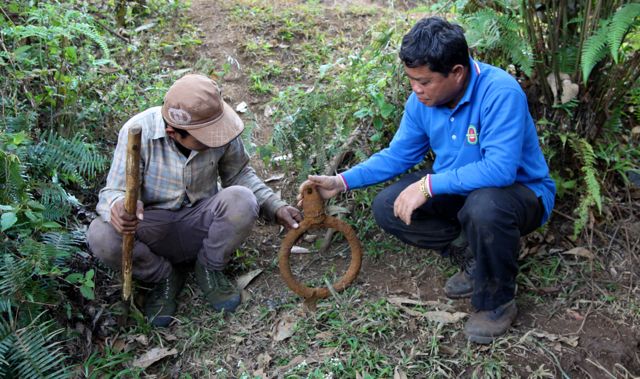
Late yesterday afternoon the guys finished clearing a farm, the fifteenth in fourteen days, but we still had slightly over an hour before the end of our normal workday. Was there time to squeeze in another job before we called it quits?
The guys had worked hard all day, but their workday is difficult everyday. If I start giving up work hours as a reward for effort, by rights, these guys should always work six hours and get paid for eight. So…we pushed on to a small job that looked to be a perfect fit for the time remaining.
And it was. We found some interesting scrap that gave our team leader a chance to show off his mastery of the ordnance manual. I have images of nearly 300 different kinds of ordnance that we’re likely to find here. They’re in my computer. Our team leader has them as well—in his brain.
To be on top of things here, you not only need to know what many diverse items (rockets, mortars, grenades, cluster bomblets, shells, projectiles, and mines) looked like when they were factory fresh, you must also be able to identify them in a myriad forms: rusted, broken, decayed, corroded, mud-caked and more.
When we visit Lao schools to teach bomb-risk we prefer to show students an artist’s representation of a piece of ordnance, rather than an actual photograph. The absolute realism of a photographic image would leave students mistakenly confident that they could recognize the item if they encountered it. Better that they leave the classroom with an imprecise notion of the item’s appearance so they are wary of any object that bears a generalized resemblance.