Complete text of lengthy interview with parents of schoolgirl killed by old ordnance.
Date: February 2015
Location: Dak Cheung District, Lao PDR.
Topic: Fatal accident that occurred on 9/30/14
Victim: Sunsamay, age 12
Participants: James Harris We Help War Victims
Ko Interpreter
Chansamay Victim’s mother
Keophouvong Victim’s father
Neuphet UNEODCOOPER Team Leader
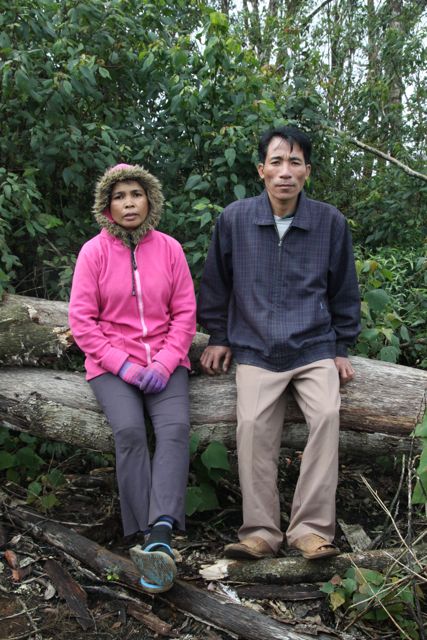
Ko:
Good morning. I would like you to introduce yourself.
Father:
Good morning. My name is Chansamay. I work for the Dak Cheung District Agriculture Office. I have my farm here in Dak Bong.
Mother:
Good morning. My name is Keophouvong. I work for the District Education Office.
Ko:
Please tell me the name of your daughter and her age.
Mother:
My daughter’s name is Sunsamay. She was 12 years old and in secondary school. She was just beginning the second year in her school.
Ko:
How long ago did she lose her life?
Mother:
She was killed on August 30, 2014. A Saturday.
Ko:
I’d like both of you to explain how the accident happened.
Mother:
The accident occurred on a day when we came here to plant coffee. It was on a Saturday, when I had free time from my work. Because my husband and I are government staff, civil servants, we don’t work on the weekends.
On that day, after we finished planting coffee seedlings, we were leaving the farm. We put everything in one of our bags. My daughter told her aunt, “I will help you; I’ll carry the hoe”.
On that day we came on just our motorbike. I planned that I would take two passengers on the bike.
I was just getting dark; it was about 5:30 PM.
My daughter picked up the hoe and started walking along the fence line. I didn’t see the accident happen because I was walking in front of her [and the others]. I walked ahead, two or three meters in front of them. My daughter walked behind me and another lady walked beside her.
Suddenly, I heard a blast — just like a shotgun. Boom!
I thought someone shot a gun. I wondered, “Why are people doing this? It scares me!”
I took another step ahead. Then, suddenly my sister screamed, “Oh! The girl is dead! What are we going to do?”
I looked back and saw that she was killed instantly. There was no sound from her. Only her mouth wide open. I could see her mouth, silent, open and close.
I walked around the hole in the ground and saw that she was completely out. Not a sound from her.
I didn’t know what to do, so I called my brother.
I tried to lift her, but I was frightened. I didn’t know what to do because she was already dead. At first I saw no bleeding.
I had my gloves on. Then, I reached down and touched her forehead where there were two small holes. I used my two fingers to rub her forehead and suddenly blood gushed out of her forehead, spurting. I fainted on the spot.
When I regained consciousness I cried…and wailed… hysterically. I screamed, “Please help me! I’m going to die!” I didn’t know what to do.
My sister and a friend went to the [main] road to ask passersby to help. She tried to get an ambulance to come from Dak Cheung and rescue us.
Two other friends sat and waited with me. Then, they went to the road to catch the ambulance if it came down the road. I called to them, “Can one of you wait here with me?”
They said, “No, I’m afraid! Because it’s dark already.”
So, I decided to let them go and I stayed alone with my daughter. I was alone with her for about thirty or forty minutes.
Suddenly, I felt faint again. I was still conscious but I felt like I would die. I couldn’t stand up or move my body. I had my hands across my chest. I tried to focus.
I knew that my daughter was dead. I pulled on her twisted leg to straighten it. Her body was still soft. I thought maybe her leg was off but it wasn’t. I saw that the flesh was torn so I patted it back in place.
I then felt faint again. I tried to stick my finger in my mouth to pull on my tongue. I touched my ear. It was still there. My entire body felt numb. I thought, “Maybe I was also hit by the bomb”.
I cried as I checked my body, my arms, and my legs. I tried moving. Nothing wrong. Every part of my body was intact. The only feeling I had was numbness. I could not stand up. I just sat there next to my daughter.
Suddenly, I heard the sound of a Chinese motor tractor: a “tok-tok”. It came close to me, as close as that tree [She points to a nearby tree]. I called, “Please help me!” I could not move.
The driver ignored me. He didn’t say a thing.
I called again, “Please help me!”
One of the passengers on the tok-tok asked, “Are your arms and legs still attached?”
I said, “Nothing’s wrong with me”. But, I was covered with my daughter’s blood because I had poked my fingers into her wounds [and was spurted with her blood].
The driver said, “Please get out of the way. I’m going home”.
He didn’t provide any help at all. I told him that I couldn’t move.
“You need to help,” I said. “Pull me up. If you don’t, how can I get out of your way?” I thought, “I’m going to die with my daughter”.
The tok-tok driver just stood there and watched. I wanted him to pull my daughter’s body out of the road, so he could pass by.
Father, interrupting:
People nowadays don’t have any heart to help others.
Mother:
It’s not that the tok-tok driver didn’t want to help. He was afraid. I was covered with blood because I was near my daughter and her blood flowed onto me. Because I poked her forehead — that’s why the blood came out.
Ko:
Where did you poke?
Mother;
Right on the two holes in her forehead.
Ko:
How big were the holes?
Mother:
Just large enough for my fingertips to fit in the holes. Before, no blood came out. She was bleeding from her legs and arm but not from her forehead until I put my fingers there. From the moment I poked the holes in her head the blood spurted out. My body was covered with her blood. After I poked, the blood spurted out and I passed out.
A moment later, Mr. Tha and Mr. Chan shouted down the trail to me. He asked me, “Have you lost an arm or a leg?”
Ko:
So…you passed out?
Mother:
This is how I felt: [She first kneels and then demonstrates how she lay on the ground]. I was crumpled on the ground. Then, Mr. Tha and Mr. Chan pulled me up and sat me on a tree stump.
“Don’t cry,” they said.
I said, “I’m so glad you came. Please help me”.
They asked if I was okay. I said, “I’m okay. I’m fine”.
Father:
The people didn’t understand the problem. If people had understood, they could have helped.
Mother:
I said, “Please help me. Give me some water”.
And, [thinking I was wounded] they said, “No we can’t give you water”.
I saw a water bottle on their motorbike. I asked again, “Please give me that water. I’m thirsty”.
They insisted, “No we can’t give you water”.
I said, “Why not? I’m going to die, just like my daughter!” I don’t recall exactly what I said; I was hysterical.
Father:
She was outside herself. [No exact equivalent in English. Has metaphysical implications].
Then, the ambulance arrived. It was completely dark by then. They put me in the ambulance. I again lost consciousness. I didn’t wake up until we reached the hospital.
Father:
She wasn’t strong, like a man.
Mother:
They put all my clothing and my equipment in a rice bag and sent it to the hospital with me.
Meanwhile, my husband was sitting in [? town]. He was attending a meeting. Once he heard the news he returned immediately — the same day.
On Sunday her birth parents came to Dak Cheung. Somebody had called them on Saturday night, but they couldn’t make it that evening because it began pouring rain. Before the accident there was no rain but after Sunsamay died the rain poured all night.
I told her birth parents, “Since I raised her from little until now I will take care of the funeral”.
Because I had pledged to them, before, that I would raise her like my own daughter, send her to school, provide everything that she needs. Her birth mother and father had so many children they could not feed them all. As a matter of fact, they had eleven children.
Ko:
Where were her birth parents from?
Mother:
They were from Dak Seng village. Her father was the naiban of that village and he was happy for us to adopt her to raise as our own.
Father:
He was Mr. Khamheng
Mother:
On Sunday her father came to Dak Cheung.
Father:
We tried to raise her properly but accidents happen.
Mother:
We took care of everything — all the costs from the ambulance to the funeral. I had help from my younger brother. And, from another brother who lives in Vientiane. They helped us with the cost.
I was given an I-V at the hospital. I wasn’t able to move my body in the hospital. I slept. I was still in the hospital when her body was prepared.
I cried and cried. I told the doctor that I wanted to see my daughter but he wouldn’t allow me to be released. They said, “You don’t need to go, everything will be managed without you”. They said, “This is part of the cycle of life”.
I insisted on going. But…the doctor said, “No”. So…I thought to myself, “Maybe the doctor is right. But, I want to see her face.”
I asked my younger brother to go to our house and collect all my daughter’s clothes and other possessions and take them to the burial site. Sunsamay’s birth father said that he would observe all the proper traditions.
Her birth father said, “I do not blame you. We will continue to have good relations”.
He wanted to know the complete story — whether she truly died at the garden and not elsewhere. I was still in the hospital, hooked to the I-V, when her birth father went to the accident site with the village militia. Six village militia went to the site. That’s seven people counting her father; eight counting my own father; all went to the site.
Actually, all total, over ten people went to the accident site to investigate — that included three staff from my work place. They concluded that it was UXO. They said it wasn’t a cluster bomblet because if it was, I wouldn’t have survived. I was very close to her — about four meters away. Or, even three and a half meters. I’m not sure. The others were also very close because we were all walking on the same path — walking in the same tire rut. What you see now isn’t how it was then. The path was only about one meter wide. The road, at that time, wasn’t as clear as it is now.
Nobody thought that there might be UXO on the road, so my daughter walked along, taping the hoe on the ground.
In my life, I’ve always been aware of UXO because this area is contaminated. We see craters everywhere. When I planted coffee seedlings I never let my daughter dig. I always dug the holes myself. She only put the seedlings in the ground and filled the holes with soil. Her father also forbade her to dig in the ground. Only we parents did the digging.
Ko:
Who did you forbid?
Mother:
My daughter. I was worried, since she was so young, that she might not dig carefully.
Father:
We only let her fill in the holes.
Mother:
She only filled in the holes; we did the digging because I worried that a child could be careless when they dig — if they jabbed the soil too hard.
Father:
No, we didn’t ever let the child dig. All the digging was done by us.
Mother:
We think the accident was fated. This happened to us. I wish it would never happen to anyone, but it happened to us.
The person who walked side-by-side with my daughter wasn’t injured, but she was deafened in one ear.
Ko:
So, how many people, in total, walked in your group that day?
Mother:
Five people.
Ko:
What are your thoughts about old ordnance still killing people to this day?
Father:
In my own opinion I wonder why, after forty or fifty years, there are still bombs left? The bombs left here are still dangerous.
Ko:
And, about your land — still not cleared of UXO. How do you feel about digging, planting, growing coffee on uncleared land?
Father:
I am very aware of the danger. So, when I’m digging I try not to force anything; I try to dig lightly, using just enough force for me to plant the coffee seedlings. You know, I want to have a coffee farm like other people around here.
Ko:
So, you are afraid of UXO.
Father:
Yes! Definitely! Like I said: yes, I am afraid.
Ko:
What would you say to other people who do not yet have their land cleared of UXO?
Father:
I would tell them, “If you have uncleared land, please clear the brush very carefully. If you cut the brush pay close attention to how you do the cutting.
Ko:
What do you ask of the people who donate money to fund clearance work?
Mother:
We know the problem exists. I urge projects to come here and help us clear our land. In the village meetings that I attend I always propose to the naiban that he should inform us, the farmers, about which lands have yet to be cleared. To reduce the threat of fatalities, I urge the village authorities to inform us about the presence of UXO.
In the village meeting I asked for a report on UXO. And, for uncleared land I would like a project to help us clear our land safely.
We want the land for our farming, so we can develop ourselves, like other people. Before, I never had any coffee land. I asked my sister to give me a parcel so I could grow coffee like other people. She gave land to me.
Four times I requested to the authorities that someone clear my land. I submitted requests to UXO/Lao many times. I requested help from CARE and I also asked commercial companies to clear my land. The Department of Social Welfare interviewed me about the accident — our bad situation.
I urge people to understand that if we don’t farm we don’t have any way to advance ourselves. What are we going to do?
For the future, I request the UXO agencies to come and help us clear our land. That’s what I ask of the authorities. For the loss of our loved one — there’s nothing that they can do about that.
Ko:
How old are you?
Father:
I am thirty-nine years old. My wife is forty.
Ko:
So you were not even born when the bombs were dropped. Ordnance dropped before you were born, kills your daughter.
Mother:
I feel sad and upset about the accident that happened to my family. But, what can we do if we want to advance ourselves and improve our lives? Although we are civil servants and work full time, we want to use our free time to improve ourselves. Besides relying on our pay, we work on the weekends to earn extra income.
Now that the accident happened to our family I am very discouraged to continue. I have abandoned this farm for almost six months. If you hadn’t asked me to meet you here today, I wouldn’t be here.
Ko:
Why have you not come back?
Mother:
I’m afraid. It’s like I will see the scene again. I still have the images in my mind. She died in my arms. I had to wash her blood off me. I don’t want to ever see that image again.
Ko:
Do you still want to grow coffee?
Mother:
We completed the planting on the day of the accident — 5,300 seedlings in total. We bought all those seedlings ourselves. It was our first attempt at coffee farming. Some seedlings were provided by my sister. My friend Souda and her brother also gave us some seedlings. Our farms are connected to each other.
Ko:
So…since August, when the accident occurred, this is the first day that you have returned to this garden?
Mother:
Yes. Just today. I will never desert our farm but at this time I cannot face the scene. Perhaps in the future — many years from now — when I can focus again I will return and work this farm again.
I still have images of the accident in my mind. The scene when she died always comes back and haunts me. When I close my eyes to sleep I still see it. I can even hear the voices. I’m still living in that horrible time. That’s why I don’t come here.
When I travel past the intersection I always close my eyes. When I reach Dak Run village I open my eyes again. It’s not that I don’t want to see the farm again. It’s just all the feelings and the images that I have. I just cannot forget them.
Ko:
What about the United States? The country that dropped much of the ordnance?
Mother:
To be honest, I feel angry. Everybody wants to live. The accident happened to us. We are very upset. I’m very sorry.
My daughter — I raised her from when she was just this tall [Indicates toddler height] until she was a young person. I still miss her. That’s all I can say now. I feel sorry about everything.
Ko:
So…any message to people who dropped ordnance on this area?
Mother:
I want to tell them about my feelings — about my sorrow. I want to ask them to help us by whatever means they can. Most important, I want them to help us clear our land.
Secondly, I want to ask them to provide whatever assistance they can. Such as, compensation for the death, if there is one. It would help if they could help pay for the hospital and the funeral. If they have available money.
I’m asking that they help us if there is a policy of providing compensation to UXO victims. I’ve heard said that someone makes payment for burial expenses. I know about this because I have been working with authorities in the UXO sector. I think that policy has been extended to villages such as Ban Chaling and Dak Bong.
This year I could not participate in the [UXO safety] campaign because the trauma of the accident hit me. If I went to meetings to share information about UXO and discuss the accident that happened in my family I would break down and cry. It would be too painful.
Speaking from my heart I ask that if there is any assistance, please help us.
Ko:
What are your thoughts about the ordnance having been dropped so many years ago?
Father:
I’m very upset about this. I want the people involved to help us clear our land and, if there is any compensation, to provide it to us. I ask this of any international people, because my daughter died in this accident. I would like the Americans to help us with financial support.
Mother:
I have proposed this to many organizations — to support us — but I don’t get any encouragement. My feelings right now? I feel left alone and really upset.
I want to improve our standard of living. How can we improve ourselves if the danger is still there? What I’m begging for now is to help us clear our farm, where we want to make a living.
Secondly, I want them to help us with support. As a mother, I have lost a lot of money for funeral and hospital expenses, ceremonies. And, the like.
Mother:
People ask me, “If the land was not cleared, why did you farm there?” They say, “You knew this was an old battlefield, why didn’t you choose a better place?”
Well, in our own minds, we were suspicious that the land held UXO but we didn’t know it for a fact. When the accident happened, then we said, “Oh my god! It’s really happened to us! UXO is truly here.”
In the past, we didn’t see any UXO. We only thought of the possibility. Not just me. Everyone else thinks that UXO is probably underground somewhere. But, we didn’t see it. So…we went ahead and farmed. Then, it happened to us. We’re upset and we want to share our sorrow with other people and tell them that they need to be careful. I have talked and talked when we have village meetings.
Ko:
What kind of girl was your daughter, as a person?
Mother:
She loved to go to school. She was a quick learner — not first in her class but second or third. She liked both singing and dancing. She was in a school singing and dancing club. She didn’t much enjoy sports.
She was just twelve years old and didn’t much like leaving the house. I taught her a lot: how to behave properly and how to conduct herself.
You see, I had difficulty bearing a girl. I had only boys. So, when I adopted her I was so pleased. She became my daughter. Even though I wasn’t her birth mother, she was my daughter in every way.
She had potential in education and music. She was very smart in school and focused on her education. She liked to sing and dance and when she came home from school she’d still be singing. Sometimes she’d use the mobile phone and dance with the music from the phone.
As to helping with family chores, I know the child protection laws; I never had her work too hard around the house. She would help with the light work.
Ko:
What do you remember from the moment of the accident?
Mother:
I didn’t see because I was walking in front of her. My sister who was walking beside her didn’t see anything either. We only heard the blast. When I turned around I saw she was lying down.
There was no smoke from the blast. Things looked normal. It sounded like a shotgun. There was no vibration [shock wave].
I was over there [pointing]. Mrs. Net was right here [pointing]. They were walking here [pointing]. Another lady was behind, over there [pointing].
The interview is joined by Neuphet, our Team Leader. He takes the parents to the portion of their garden that the team had already cleared and shows them a cluster bomblet in the bottom of a hole.
Mother: [Seeing how close the hole is to a coffee seedling].
We just missed that one, by just a little bit! Look where we planted the coffee! I’m the person who dug here and I just missed hitting that bombie! I was very close to it. I used a small spade and dug like this [Demonstrates slow movements]. I just missed that bombie. If I’d hit that bomblet, you know what would have happened. Me! I did all this planting in here.
But, the coffee isn’t very healthy here. I don’t know why. Maybe crickets are destroying it.
I did all the digging here. My daughter only filled in the holes and covered the seedlings.
Ko:
When you cleared this area of brush, in order to plant, did you find any UXO?
Father:
No, I didn’t see any. I only saw fragments.
Mother:
I never saw any bomblets — only small fragments.
Father:
I collected two or three buckets-full of fragments. The same stuff that your de-miners find. My daughter also collected scrap. Each time she collected she got two or three rice bags full and she sold it to the scrap dealer. My son and others also collected scrap and took it to sell.
Mother:
I told him, “If you find any UXO don’t pick it up”.
Mother’s friend:
My son also collects the scrap. He digs to find it; that terrifies me.
Mother:
If we stand here too long, might something happen? Because, I’m scared.
Neuphet:
No. If we don’t touch it or make contact, nothing is going to happen.
The group walks from the garden and mother speaks.
Mother:
She was my daughter. I still have images haunting me every day. I still see her dead image.
Neuphet:
You didn’t have luck raising a daughter.
Mother:
That’s right. I could not raise a girl. That’s why she’s no longer with me.
Neuphet:
It’s sad, but true.
Mother:
That’s right. Some people believe in fate.
Neuphet:
Just as fortunetellers predict.
Father:
We didn’t have a girl so we adopted her to be our daughter.
Ko:
Why, again, did you start working the land before it was cleared?
Father:
I never thought it would be 100% safe here. I knew this place used to be a battlefield. I chose the site for my coffee farm because my friend gave the land to me. Since she gave it to me, I went ahead and started farming.
I decided to farm because of the closeness and convenience. I could get friends to look after the farm when I’m not available. If I go to some other location, then I wouldn’t have help from my family and friends. Plus — other place? There’s no land available. Fortunately my friend here — she had a lot of land and she gave me this parcel so I could farm. I asked her and she gave it to me.
Mother:
Yes, I was scared. But I had no choice, because of our poverty. We had to do something. This was the only land given to me by friends. Of course I was afraid. That’s why I was very cautious when I worked. I was scared.
I had a suspicion that the area was contaminated with UXO because I could see many craters around here — three craters on our farm alone. So…there must be something here. I was very cautious, but in spite of caution this was a risk we had to take — because we wanted to farm like others do.
Since the accident five months ago I have never returned to this farm. That’s why you see so many weeds around here. Had the accident not happened this farm would be more clear of weeds and brush than this.
When I weed [in the future] I’m going to be frightened. I have it in my mind that when I cut brush I’d better cut at a high level, not low, for fear of hitting something.
It’s necessary for us to have a farm so we can earn extra income for the family. Had I known that an accident would happen I never would have worked this parcel. We got land for a farm but lost our daughter. That loss outweighs everything else.
I was scared about the land but we went ahead with farming anyway and eventually a nightmare came true. Now I’m terrified.
Ko:
Your first time back.
Father:
Because we have not recovered from the trauma. We saw with our own eyes…and that causes us pain.
Mother:
[Pointing to a cellphone photo of her daughter’s body, taken at the accident site] This is where her leg got smashed from the blast. It’s not ripped off; it’s still attached. All her fingers, her arms, all parts of her body were still attached. But this is where her flesh was torn [Pointing to the pictured body].
Her head, right here, was hit by fragments. If you look at the photo, this way, you see that her head was not torn. It only has fragment holes.
This is where I sat [pointing]. I sat right here. I could not stand up. All her blood…when it came…it covered me. She was hit just above her eyebrows.
Ko:
Do you have any photos of your daughter before the accident?
Mother:
No. They all went to the funeral with her other possessions. But the school might have a photo.
Also, I will call on Monday to see if my friend still has the accident photos on her computer. If she still has them, the pictures on the computer are very clear.
Neuphet:
I’m certain that the accident was not caused by a cluster bomblet. If it had been a cluster bomblet, then none of you would have survived.
Mother:
Other people have told us the same thing.
Neuphet:
Nope. Not a bombie. I think it could have been a fuse, or a shell. Because, a bombie? Then, you would all be dead.
The people who walked near her: none of them were injured?
Mother:
No, none of them were hurt. Only one person got a deaf ear and her hat was blown off her head into the crater.
Neuphet:
The hat fell off her head? That means that when the ordnance blew there was a shockwave.
Mother:
Maybe the blast knocked her hat off her head.
Neuphet:
If the hat had a puncture hole in it, that would mean that the hat was hit by shrapnel.
Mother:
I don’t know. Maybe frag went through the hat.
Neuphet:
No, no, no.
Mother:
The person standing next to her didn’t know anything. The only thing…she came running to me, crying. I asked, “Why are you crying?”
Then, she said, “Don’t you see? Your daughter is dying!”
I looked back and [at first I] thought it was the screaming lady who had been hit by shrapnel. She was standing right here, as a matter of fact. I thought it was her, [the older woman], who was lying down. I had blurred vision at the time.
Neuphet:
No. Not a bombie. Must be a fuse or a shell. A fuse can kill you also.
Mother:
The shrapnel hit her in the forehead and made two holes.
Father:
Right in the brain. Both holes, right here [pointing].
Mother:
Both holes, right here [pointing]. Above her eyebrow.
Father:
Her hands and her arms were both cut. The flesh on her hands was peeled off like a glove. It looked like we could peel it off.
Neuphet:
I’ll tell you this: if you think it was a bombie…
[Neuphet proceeds to describe an accident he was familiar with in which two individuals both received fatal wounds].
He concludes with the words, “If it was a bombie, then none of you would have survived”.
Later, while the parents are elsewhere, Neuphet holds a 20mm shell found on the site and explains:
When the shell is fired the head will hit the target and because it has a nose fuse, it will explode.
Ko:
So, you suspect a shell like that?
Neuphet:
Yes, I suspect this one.
Ko:
Is a small shell like that powerful enough to destroy a hoe?
Neuphet:
Oh, yes. Nothing will stop it. It would rip the hoe apart. The head of the shell is about thumb-sized. It has an impact fuse in the head. When the shell is fired the head will travel. When it reaches the target the head of the shell will explode. Boom!
It’s a different shell than a normal rifle shell — like those fired by an AK47 or M16. When you fire a rifle the head of the shell goes through the object. It does not explode.
But this one [the 20mm shell] will explode because inside the head there is high explosive and at the tip there is a fuse that we call an impact fuse.
When the shell is fired the tip hits the object and then an explosion will occur. That can kill people. Not just people it can also damage vehicles. A hoe like that? It would never stand a chance.
If the girl struck this type of shell she was very unlucky. Why? Because the tip is very small and she managed to hit it just right. That’s what I call bad luck.